
The Way it Was
In which Norm catches up to Warner's superlative 4K editions of ALL THE PRESIDENT'S MEN and BEN-HUR, and finds room for three top-flight Warner Archive collections.
I have been unwell. Just a head cold, but it lasted an entire week and wrung me out more than anything has in a while. All I managed to write was Friday’s What’s Worth Watching newsletter, so apologies if anybody on the free tier was worried I’d died. You can always bring up Bluesky for a wellness check.
But I’m back on the ball now, and catching up to the really quite ridiculous volume of discs that came out last week. Let’s start with the absolute bangers.
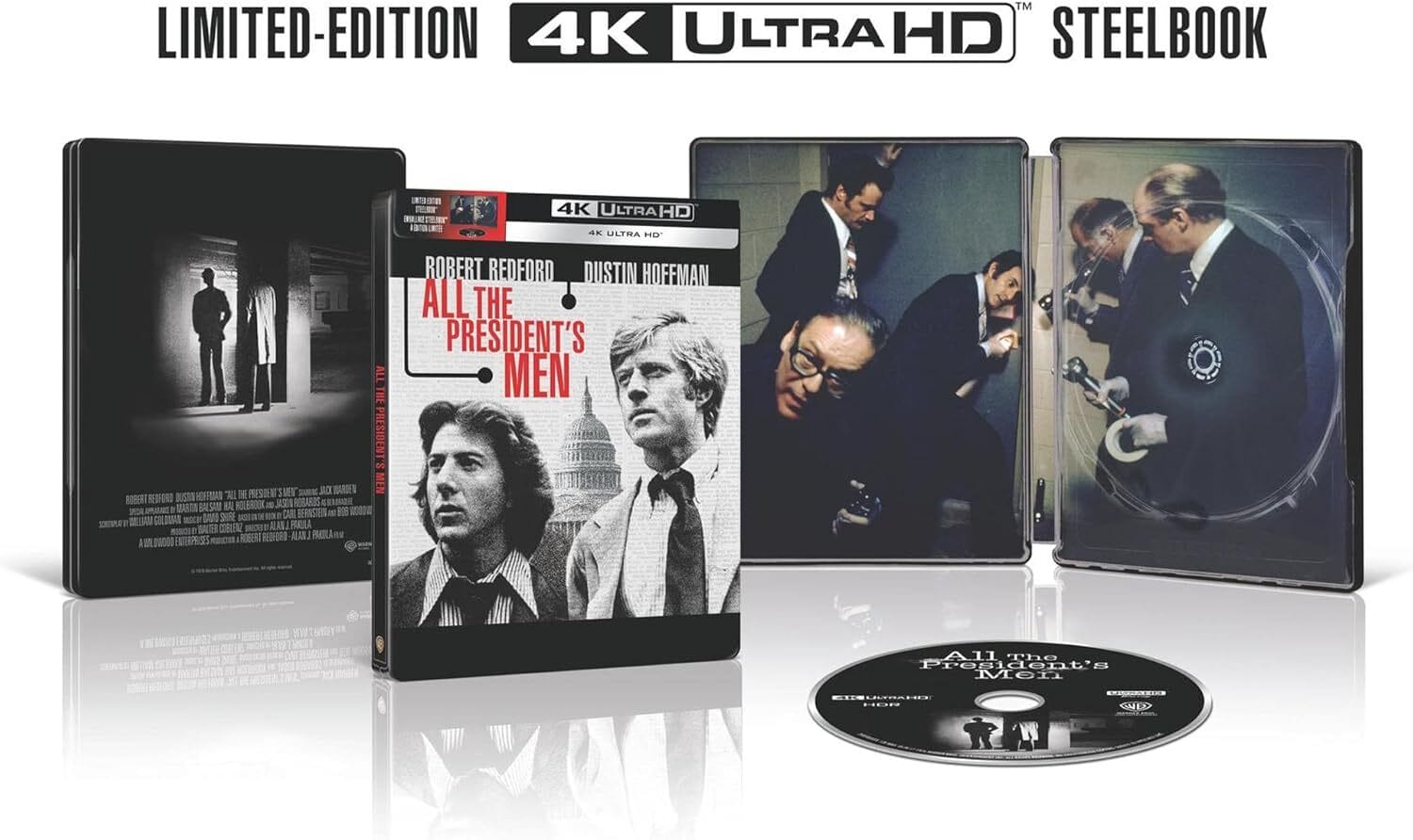
All the President’s Men turns fifty this year, and – yep – it’s more relevant than ever. Alan J. Pakula’s shoe-leather thriller was always a masterpiece of narrative and a full-throated argument for a free and independent press, but now it is itself an essential historical document: A record of what American values used to be, even among the privileged, and how the justice system could be trusted to pick up and run with whatever evidence the press uncovered, whether or not it pleased the White House.
As screenwriter William Goldman wrote in his invaluable memoir Adventures in the Screen Trade, the project looked like an impossible challenge: How do you adapt a bestseller where everybody knows not just the ending, but all the specifics? What audience member, in April 1976, wouldn’t be aware that Richard M. Nixon had resigned less than two years earlier thanks to the efforts of Washington Post’s Bob Woodward and Carl Bernstein to prove he was aware of, if not fully behind, the break-in at the Democratic National Committee headquarters at the Watergate Hotel on June 17th, 1972? Wouldn’t all that exposition be dull as dirt, just a couple of guys making phone calls and knocking on doors? Even if those guys were played by Robert Redford and Dustin Hoffman?
Goldman recounts the process as a nightmare of back-and-forths with an indecisive Redford – who was also a producer on the picture – and outside interference from various interested parties, including Bernstein himself, who at one point passed Redford an alternate screenplay written by his then-girlfriend Nora Ephron. (You should really read Goldman’s book; it’s a hoot.) But page by page, Goldman – and then Redford, and then Pakula – shaped the story to perfection.
All the President’s Men is a chase picture, a political thriller and even a buddy comedy, moving fact by fact towards the thing we already know. The story isn’t that Woodward and Bernstein got Nixon; it’s about how they got him, through resourcefulness and ingenuity and contacts and, yes, a guy in a parking garage. And all of it flows effortlessly, propelled as much by the sound of mechanical typewriters clicking and whirring as by David Shire’s score.
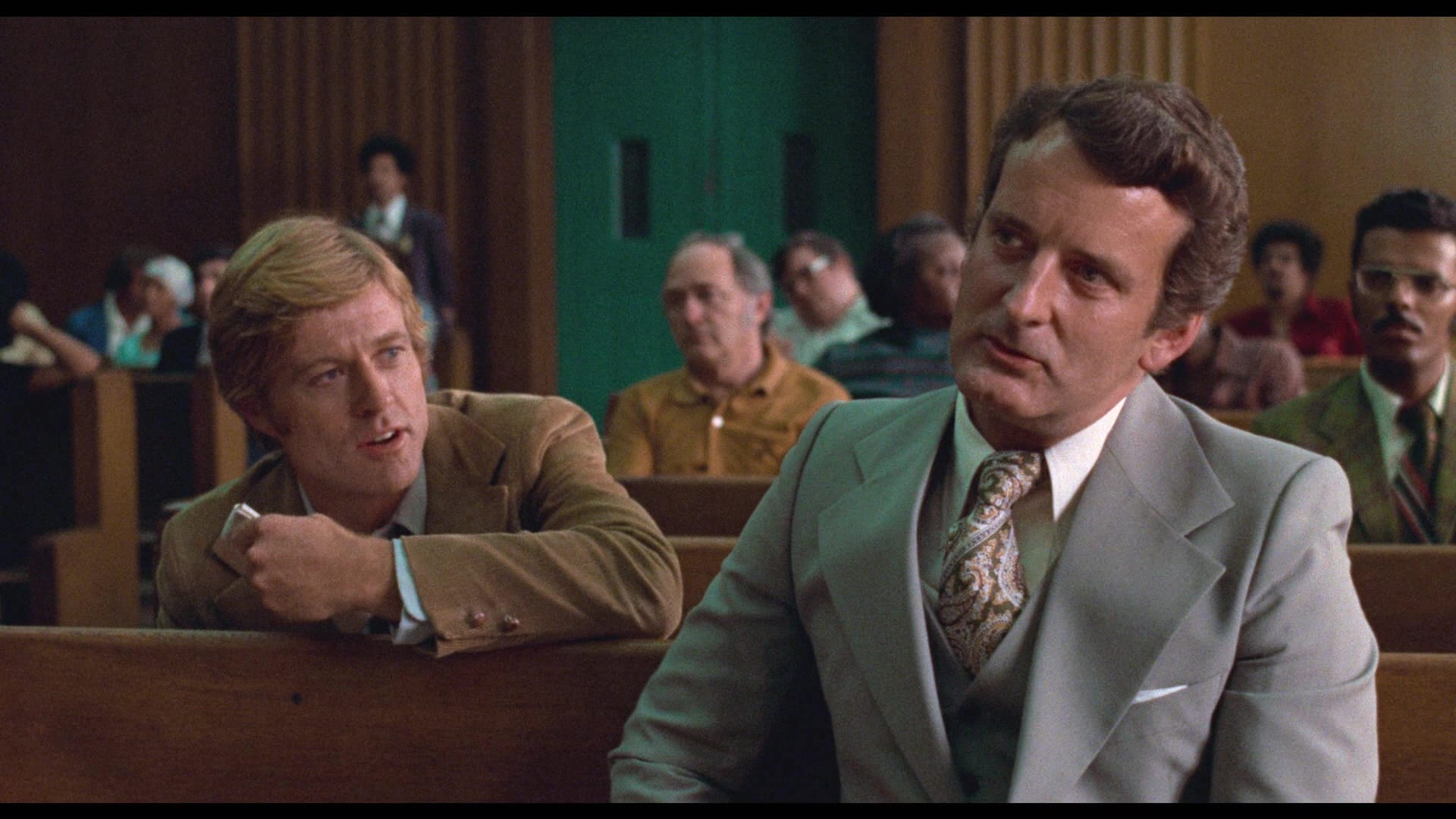
As you can imagine, Redford’s recent death makes revisiting the film particularly poignant: Not only is the movie an elegy for a noble America – or an America still capable of pretending it was so – but now it’s a reminder of how solid and subtle an actor we’ve lost. Redford could have played up Woodward’s squareness or blandness as a contrast to his own image, but he found more interesting qualities to bring out. He gives the reporter a cranky indignation at being a regarded as a rookie, bristling at the way his colleagues roll over him. Woodward seems entirely ready to belt Bernstein over an impromptu rewrite, even after he acknowledges the other writer has improved his copy. (“I don’t mind that that you did it, it’s the way you did it,” he grumbles, drawing a line between Woodward’s patient, deliberate methodology and Bernstein’s more impulsive approach.)
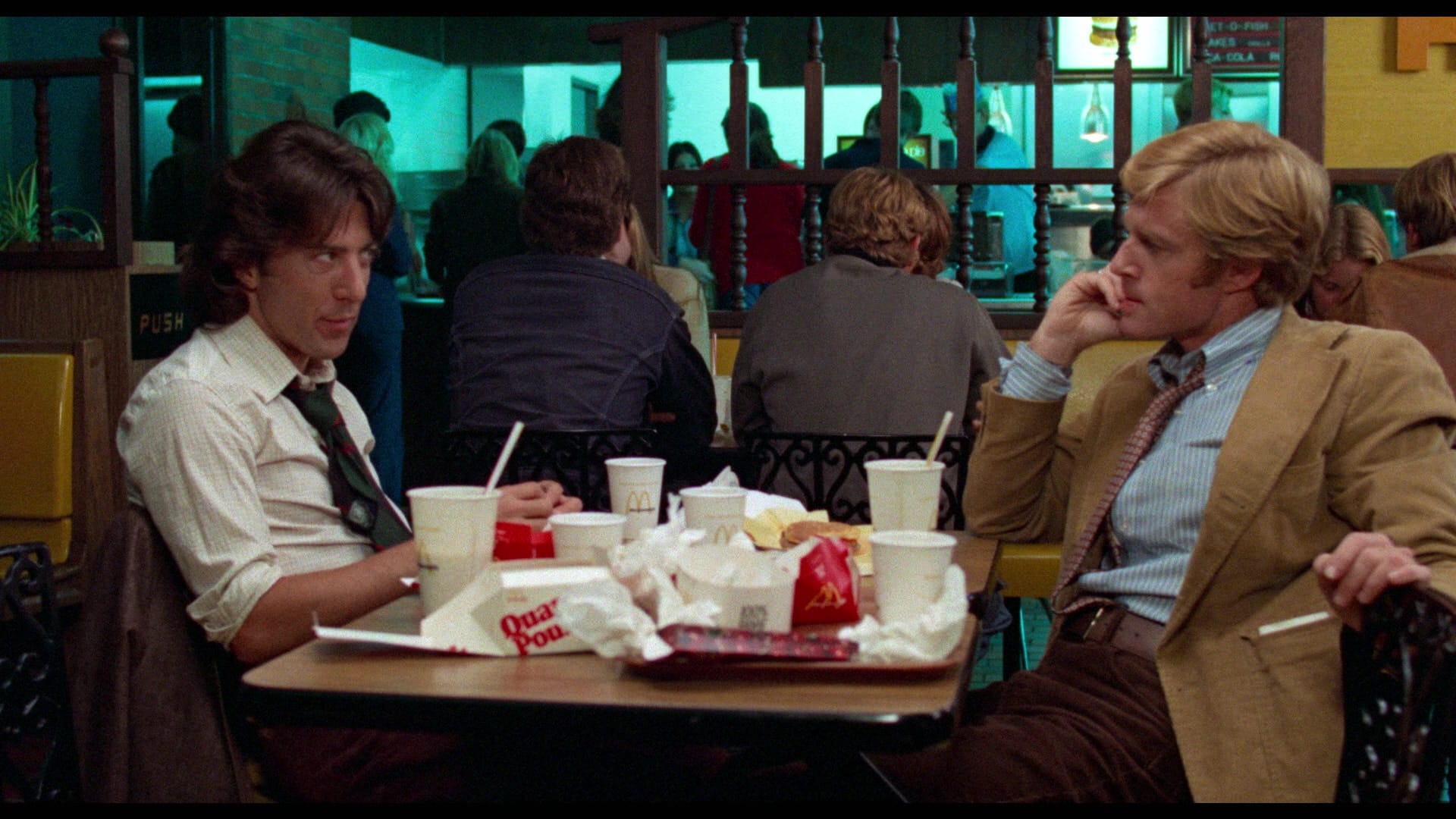
Even once they become friends, Redford lets us catch Woodward’s irritation with Bernstein’s noodginess here and there, never fully turning the corner into admiration. He doesn’t want the cookie his pal forces on him after a long day. But then we look back at his desk, and the cookie’s gone.
Redford and Hoffman are the stars, but every goddamn role is perfectly cast. Jason Robards won an Oscar for his performance as Ben Bradlee, but every actor steps up: Just look at Jane Alexander in a tiny role as a potential witness, or Robert Walden as the cheerfully rotten Donald Segretti. There’s Lindsay Crouse! And Meredith Baxter! And James Karen! And Polly Holliday! And F. Murray Abraham! Is that Dominic Chianese as one of the burglars? It is! And of course there’s Hal Holbrook as Deep Throat, delivering a rueful and layered performance as a man who knows exactly what he’s doing, and exactly why he’s doing it. He’d have been riveting in broad daylight, but he’s terrifying in the dark.
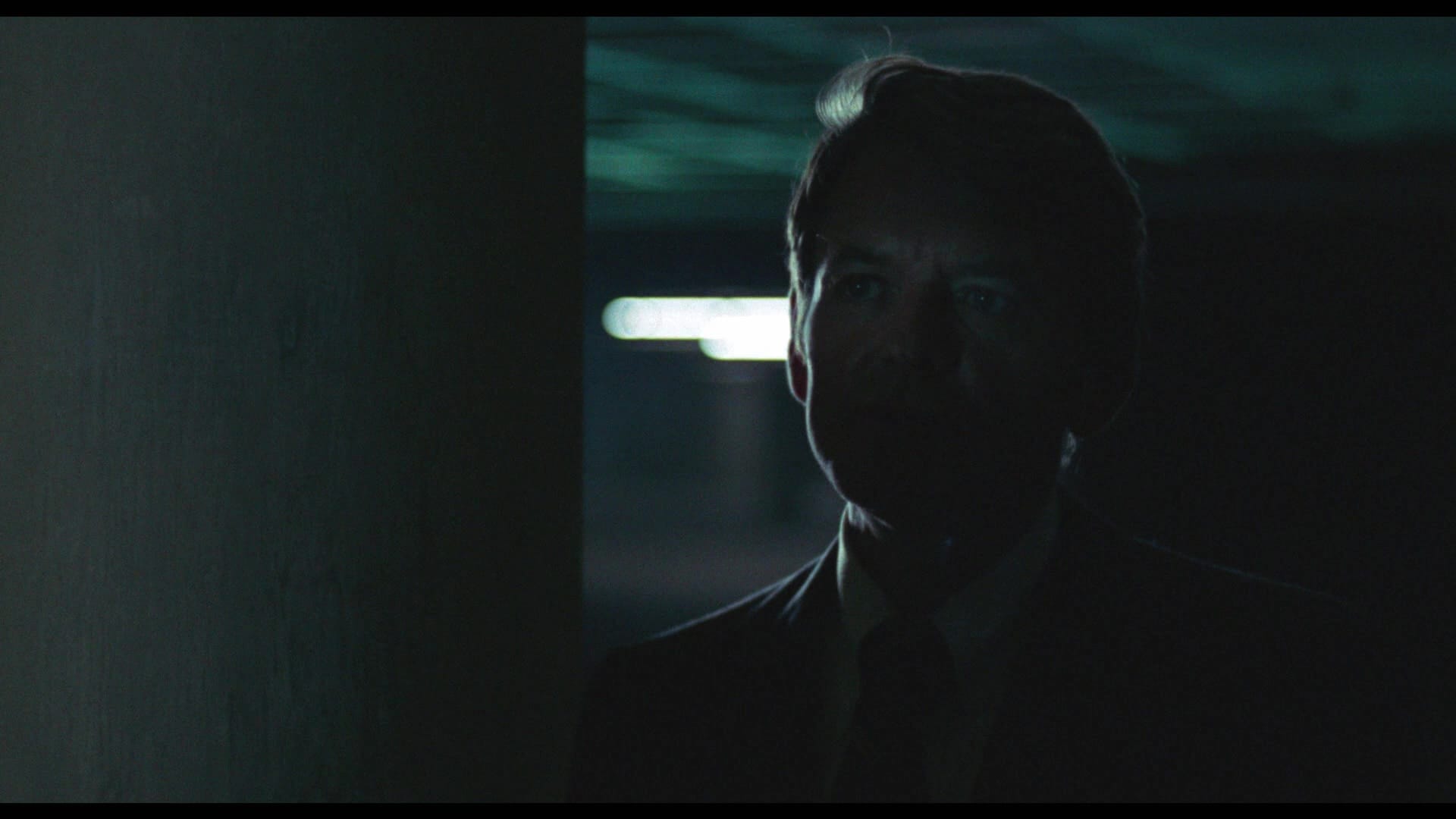
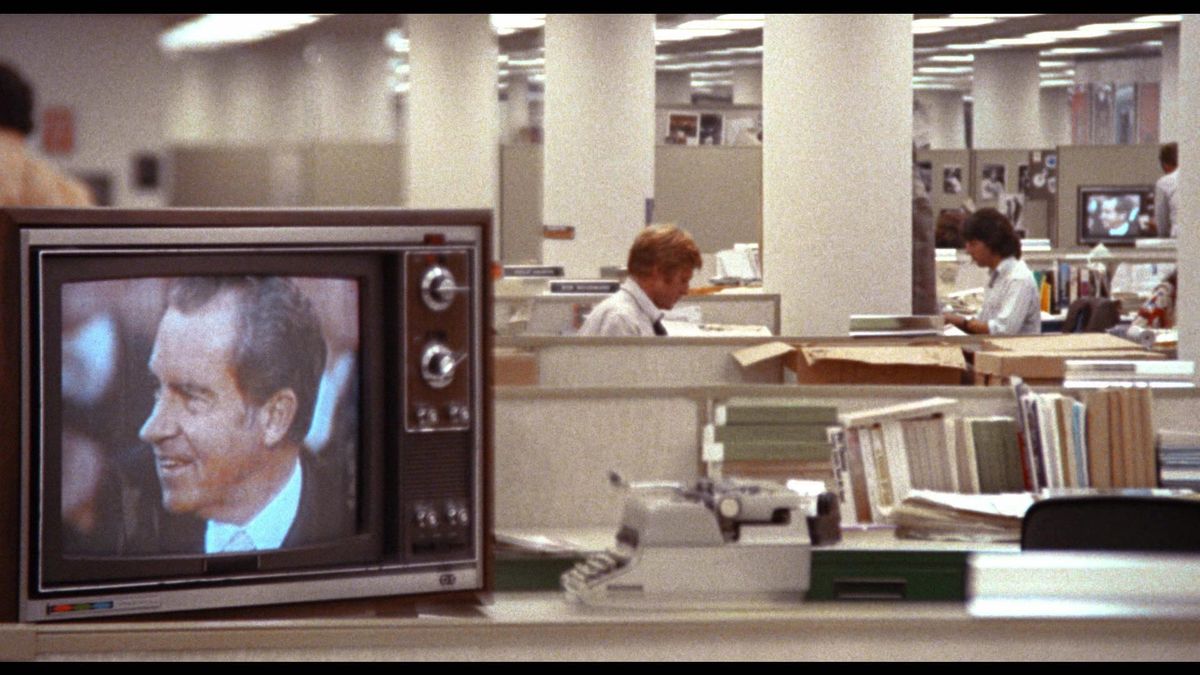
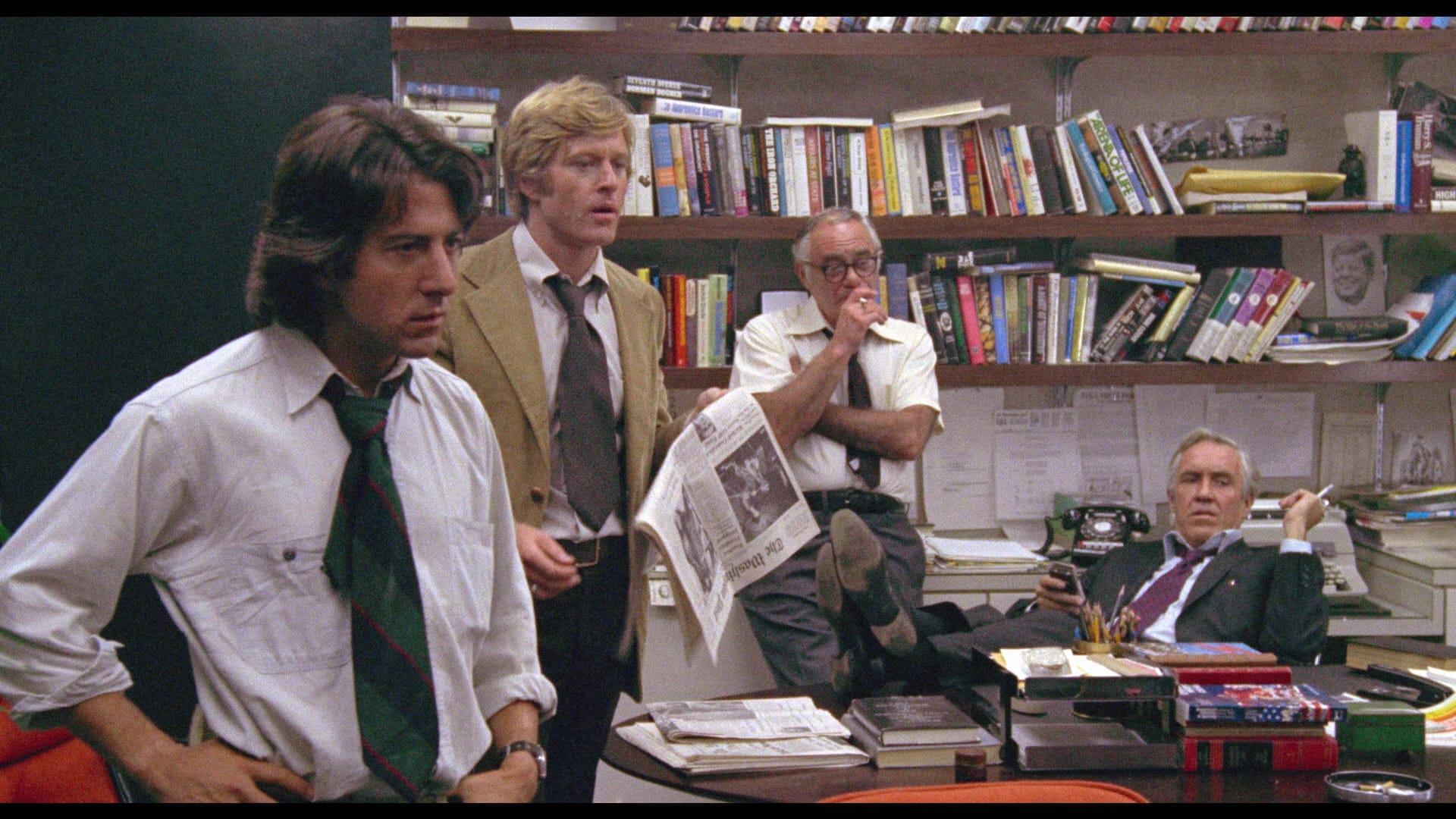
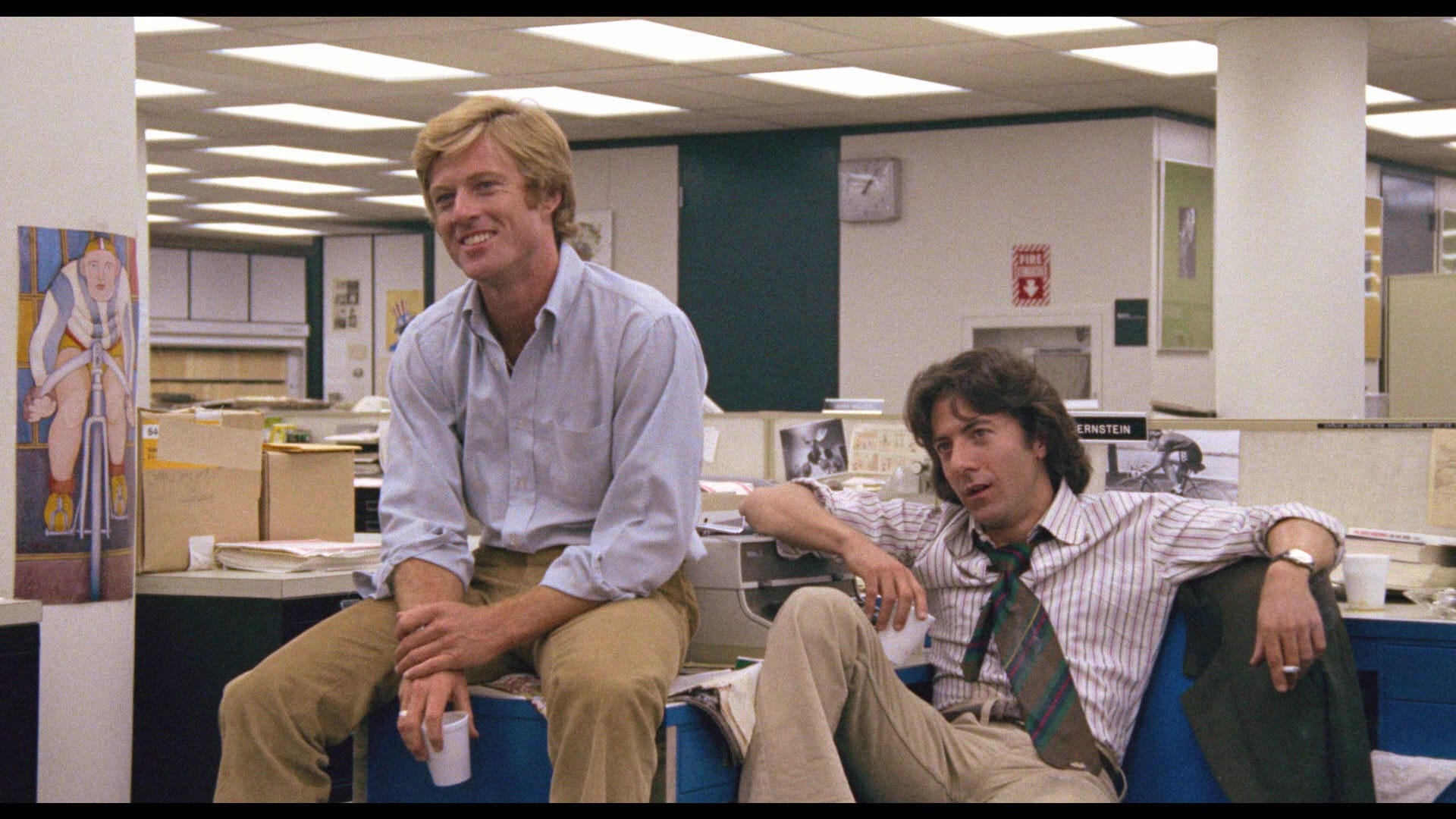
And yes, as you’ve probably noticed from the screen grabs, Warner’s new 4K restoration is the best I’ve ever seen this movie look short of a fresh print. Pakula and Willis took a naturalistic approach to most of All the President’s Men, from the harsh fluorescent lighting of the Post’s newsroom to unfussy wide shots of Woodward and Bernstein wandering around various Washington locations – there’s a shot of Redford leaving the Kennedy Center that plays very differently now, as you can imagine – and that footage has a warts-and-all quality that’s captured faithfully in the new master. But it hasn’t been possible to fully capture the inky darkness Willis brought to the Deep Throat scenes until now, with the additional resolution and enhanced dynamic range of UHD offering new contrasts in the shadows.
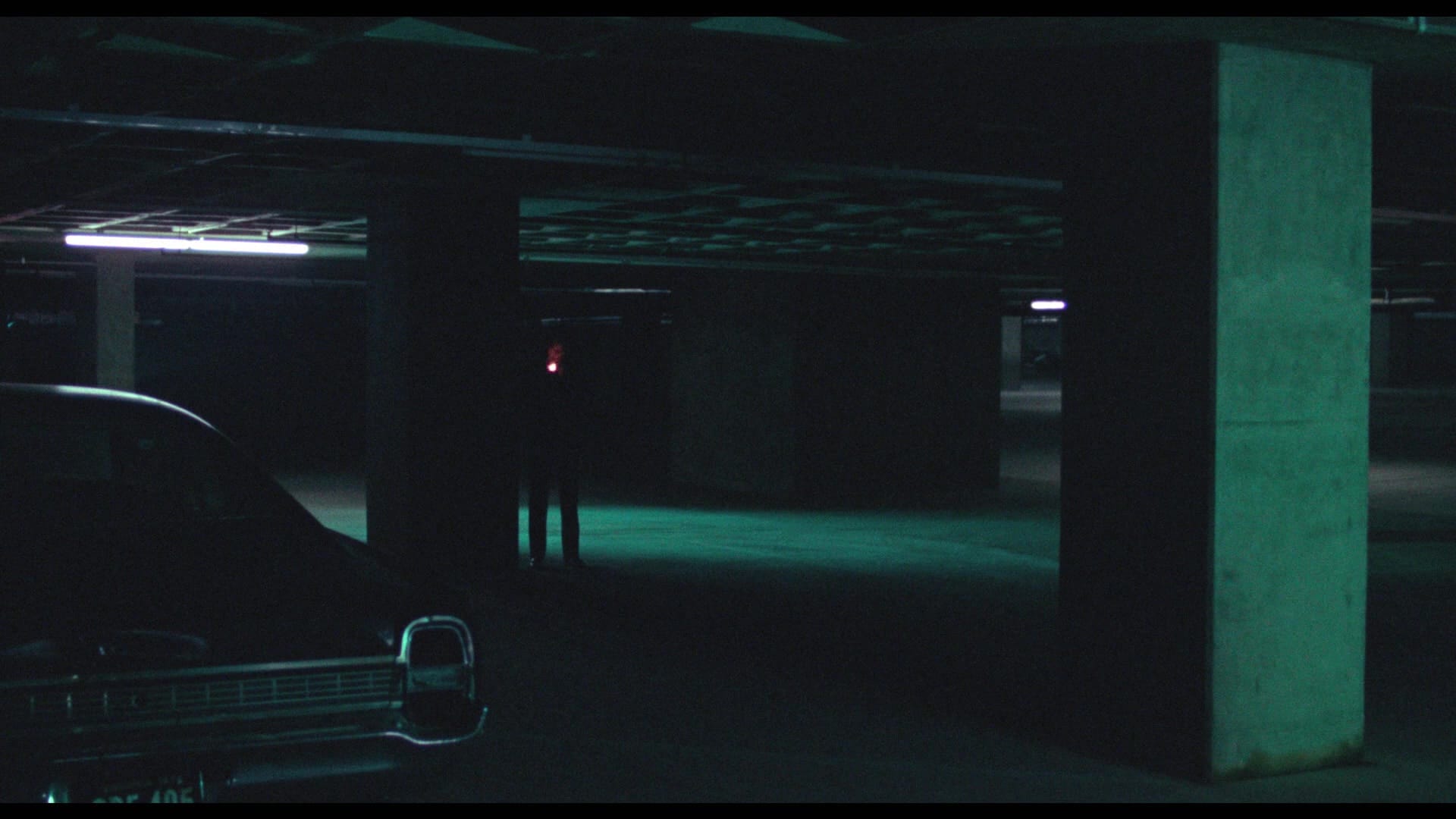
The parking garage where Woodward and Deep Throat meet has an almost liminal quality in the 35mm prints; this edition finally brings that home. It’s a beautiful disc, and purists will also appreciate the fact that no one tried to remix the mono audio into Atmos or anything fancy this time around; it is as it was, as the saying goes.
Supplements are an interesting mix of new and archival material, and I’m not sure how I feel about that. Two short retrospective featurettes approach the movie from a modern journalistic perspective: “All the President’s Men: The Film and Its Legacy” and “Woodward and Bernstein: A Journalism Masterclass” bring in CNN anchors Jake Tapper and Dana Bash to offer their thoughts on the authenticity of the film and its impact on their idea of what journalism could mean, and the careers of its protagonists; the two featurettes run about 15 minutes in total and probably could have been a single piece.
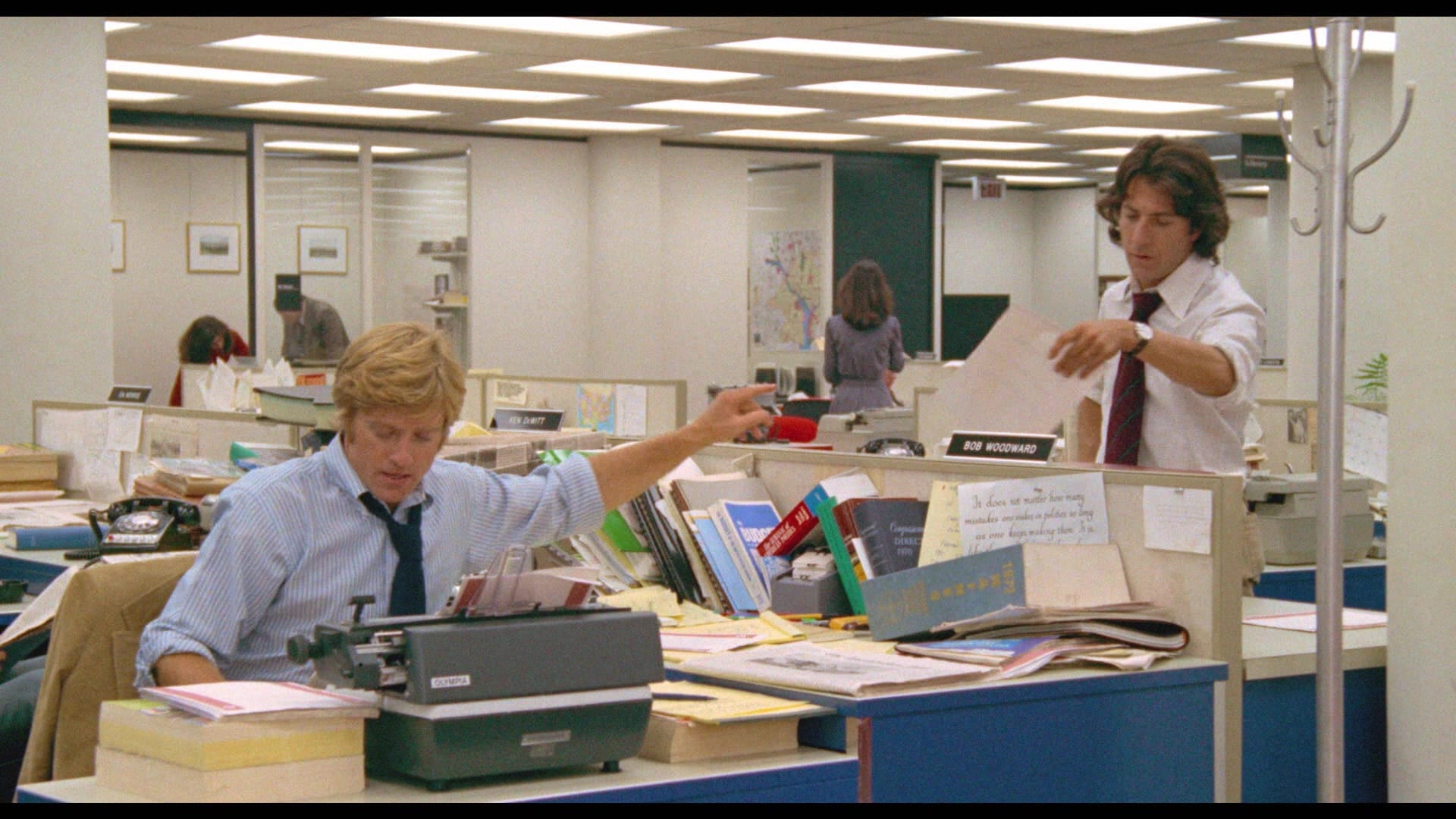
There’s a hint of self-reflection in the new featurettes about how mainstream media has failed to live up to Woodward and Bernstein’s example, but only a hint. That idea was engaged with far more in the commentary Robert Redford recorded for the 30th anniversary DVD in 2006, and in All the President’s Men Revisited, the feature-length retrospective doc included as a bonus with the 2013 Blu-ray – neither of which was carried over to this release, more’s the pity. Redford’s commentary feels even more missed now, as you can imagine.
A 1976 making-of reel also failed to make the cut, but this disc does preserve three excellent featurettes from that 2006 release (“Telling the Truth About Lies,” “Woodward and Bernstein: Lighting the Fire” and “Out of the Shadows: The Man Who Was Deep Throat”) and a fun appearance from Jason Robards on the Dinah Shore show, which offers a sense of the cultural landscape that the other documentaries cannot. People really loved Jason Robards, and people really hated Nixon. America had its head on straight fifty years ago.

All the President’s Men wasn’t the only heavy hitter to make its 4K debut last week: Warner also put out an exquisite restoration of Ben-Hur, William Wyler’s gargantuan 1959 costume drama starring Charlton Heston as a Jewish noble who becomes a galley slave and then a gladiator, and also meets Jesus a couple of times. A monster hit and Oscar champion of its day – it won 11 Oscars, a number that’s been tied but never beaten – it’s not exactly a good movie, but it’s fondly remembered by generations as the apex of the Hollywood roadshow epic, And that, at least, is true.
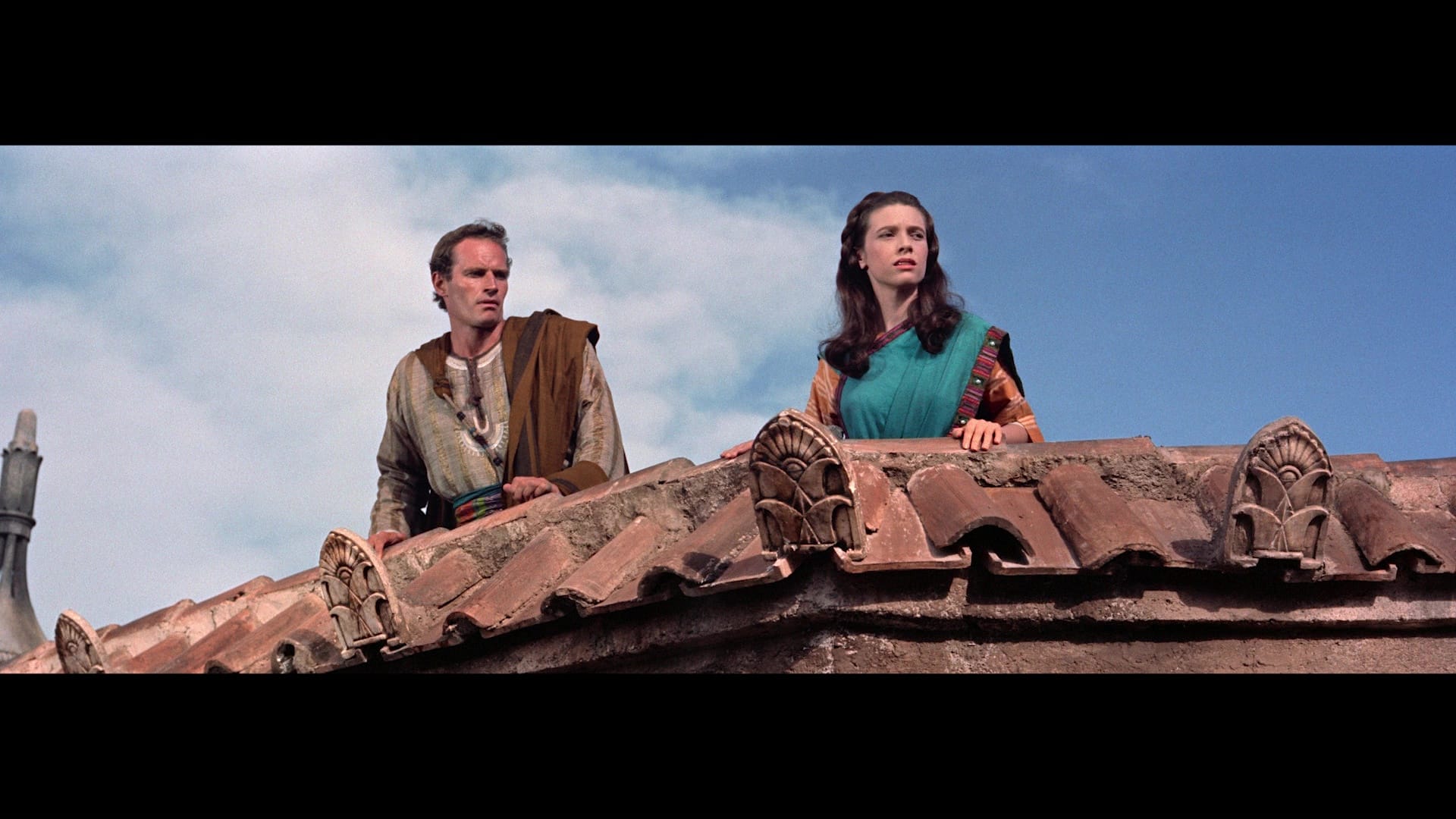
In 1954, The Robe had brought CinemaScope to theatres, offering audiences a big, important religious epic at a scale and breadth that dwarfed their televisions; The Ten Commandments followed in 1956, with Heston as a VistaVision Moses; two years later, Ben-Hur upped the ante with Robert L. Surtees capturing what felt like half of Italy in the ultra-wide vistas of MGM Camera 65. There are moments in Ben-Hur that still feel impossible – sets that seems to stretch on for miles, populated with thousands of extras, the reds and blues of their costumes popping in that Eastmancolor vibrancy.
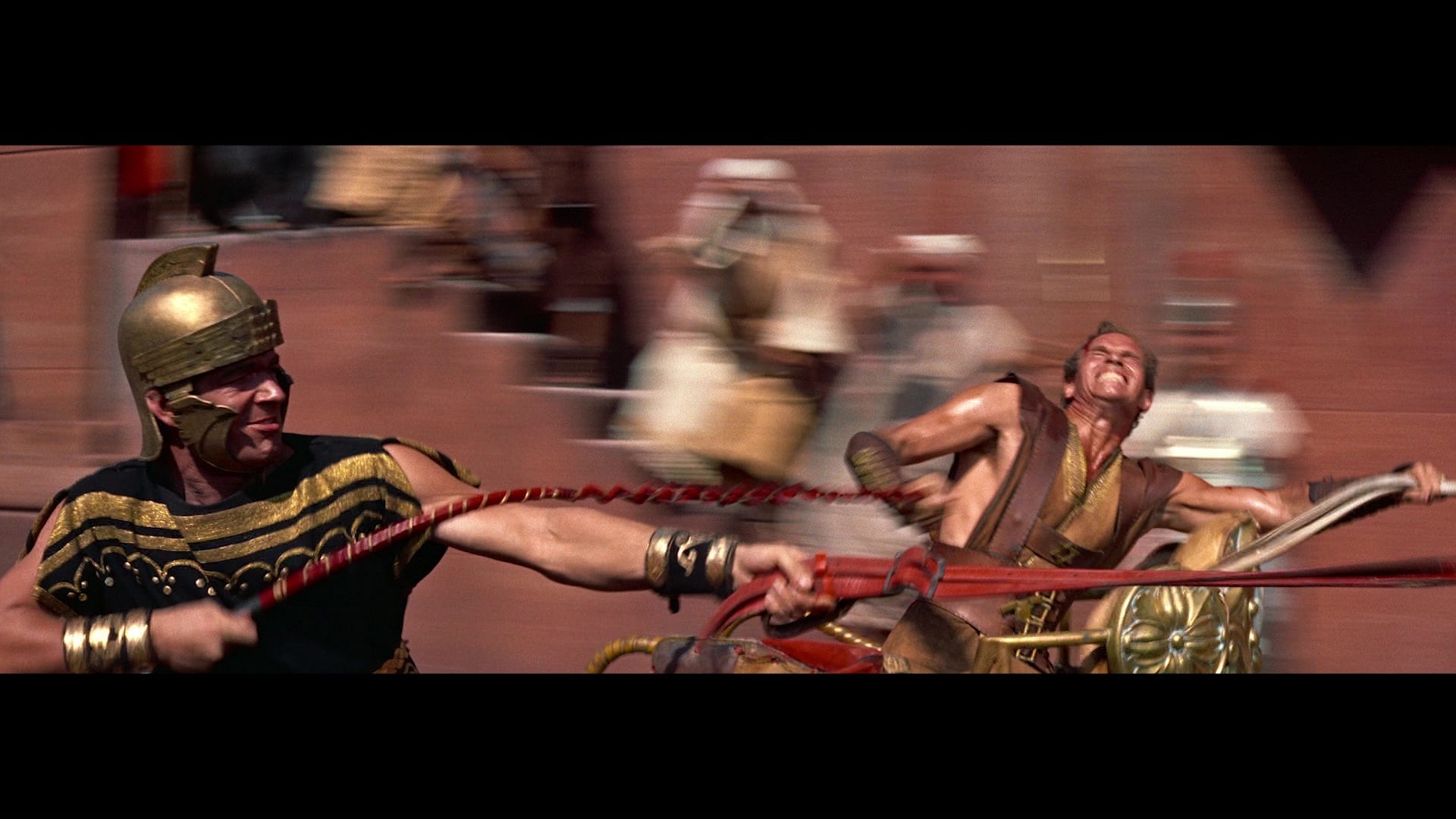
The chariot race remains one of the best-shot, best-edited action sequences ever put to film; I’ll even grudgingly allow that the scenes involving Jesus – whose face is never shown, and who never speaks – have an almost beguiling storybook quality, with a calm that sets them apart from the rest of the picture.
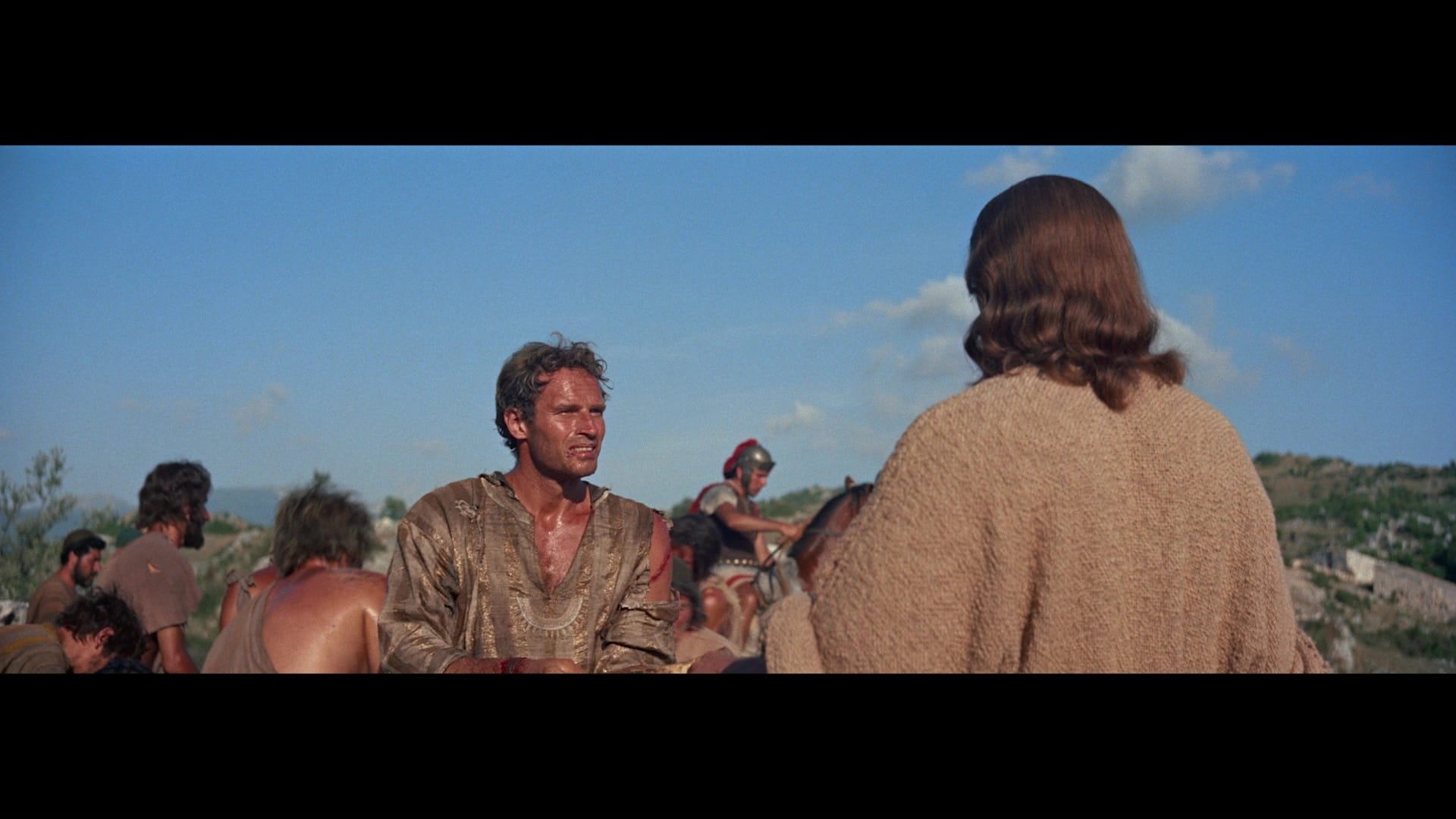
But … oof, the acting. Ben-Hur rests on Heston’s clenched, stentorian shoulders, and the man never met a moment he couldn’t oversell. This isn’t a movie that calls for emotional authenticity – its aesthetic is deliberately stiff, even stilted – but Heston goes for this tormented, wailing thing that William Shatner might even have thought twice about. It is, truly, mind-boggling to think he won an Oscar for this … especially since two of his fellow nominees were Jack Lemmon in Some Like it Hot and James Stewart in Anatomy of a Murder. But Ben-Hur was a juggernaut, and he was its face.
Fun fact: Marlon Brando was originally set to play Judah Ben-Hur a few years earlier, when MGM was looking for epics to ride the CinemaScope wave; the project fell apart, but Brando would surely have given the film a very different energy. Certainly he’d have been more willing to play with the subtext Gore Vidal claimed to have inserted between Judah and Messala in his uncredited rewrite, which imagined a romance between their teenage selves and the adult Messala responding to Judah’s resistance to his colonial overtures like a spurned lover.
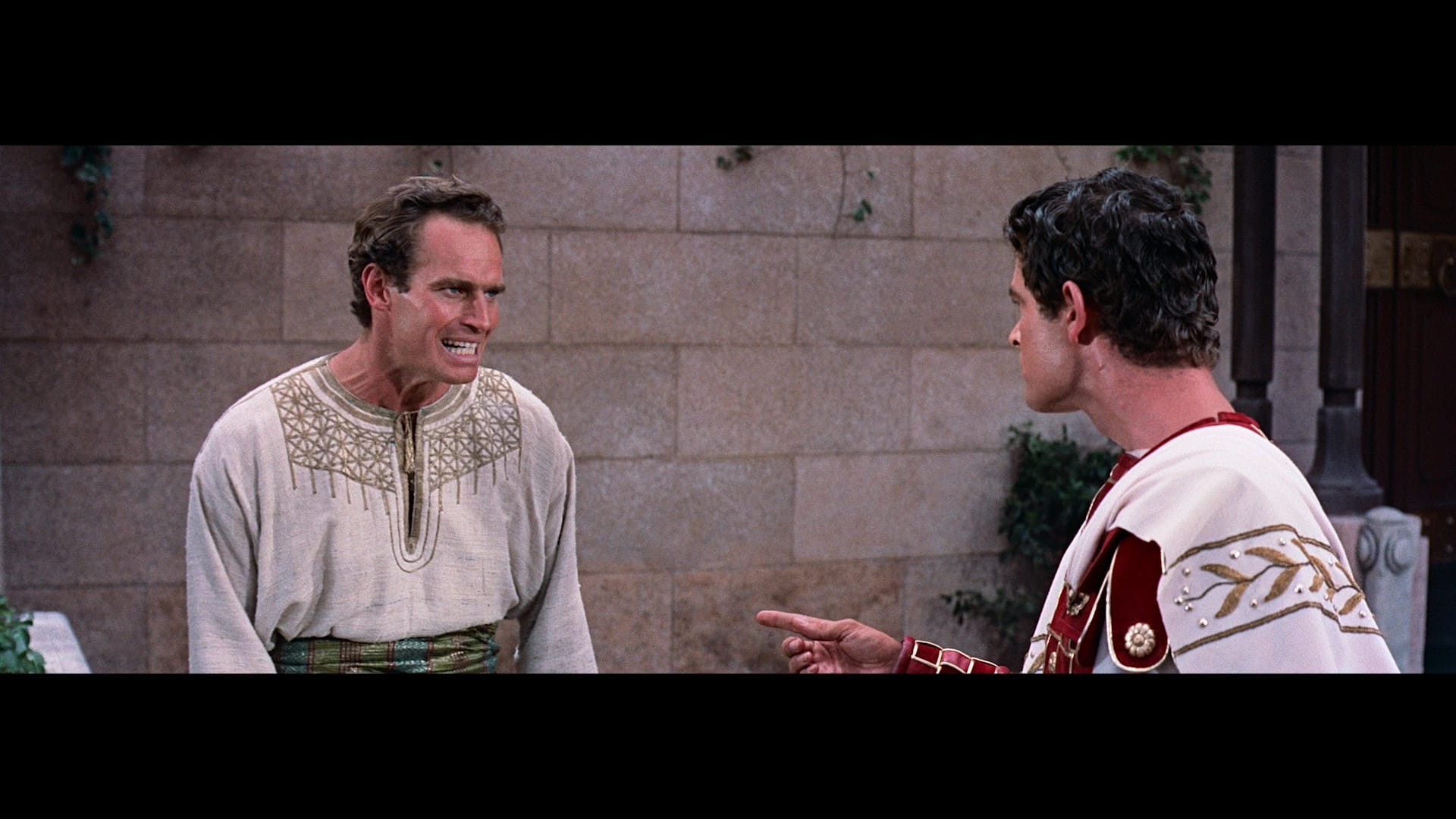
Heston would later claim no such subtext existed, but Stephen Boyd is certainly going for it … not that it helps. Boyd was not a subtle actor, and while what he does could be seen as a camp triumph in a movie more open to such things, Ben-Hur rolls right over him like it does everything else.
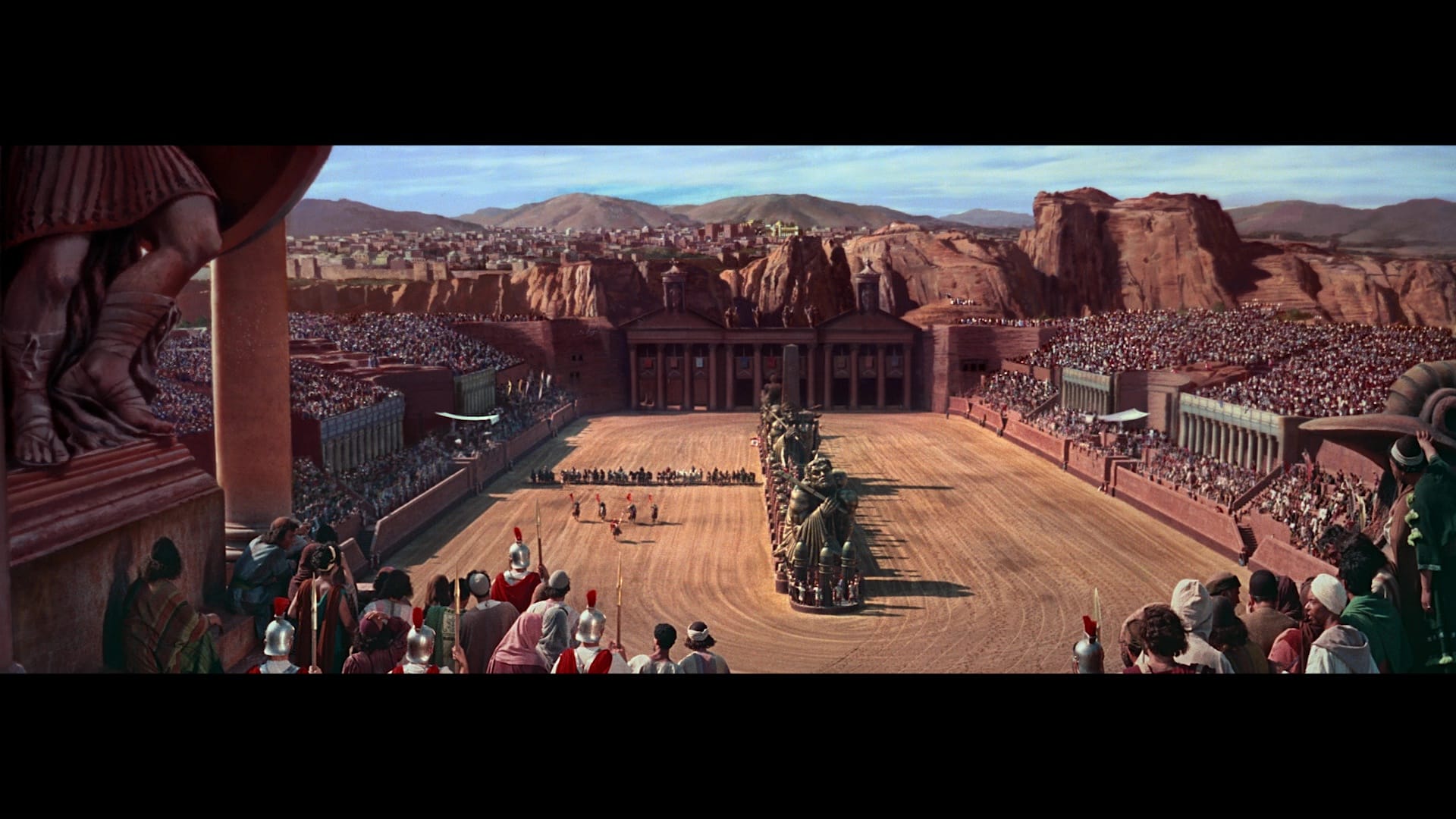
It is gorgeous, though, and if you have any love for the film, Warner’s 4K edition is a reference-quality restoration. As Warner’s restoration honcho Ned Price told me at the 2011 New York Film Festival, when the film’s first 8K restoration was screened, Ben-Hur’s negative was so badly damaged in storage that it added more than two years to the project. The negative had been given a protective coat of lacquer before it went into the MGM vault, but the coating glued the film to itself over the decades, and no matter how carefully those reels were unspooled, almost every frame was damaged.
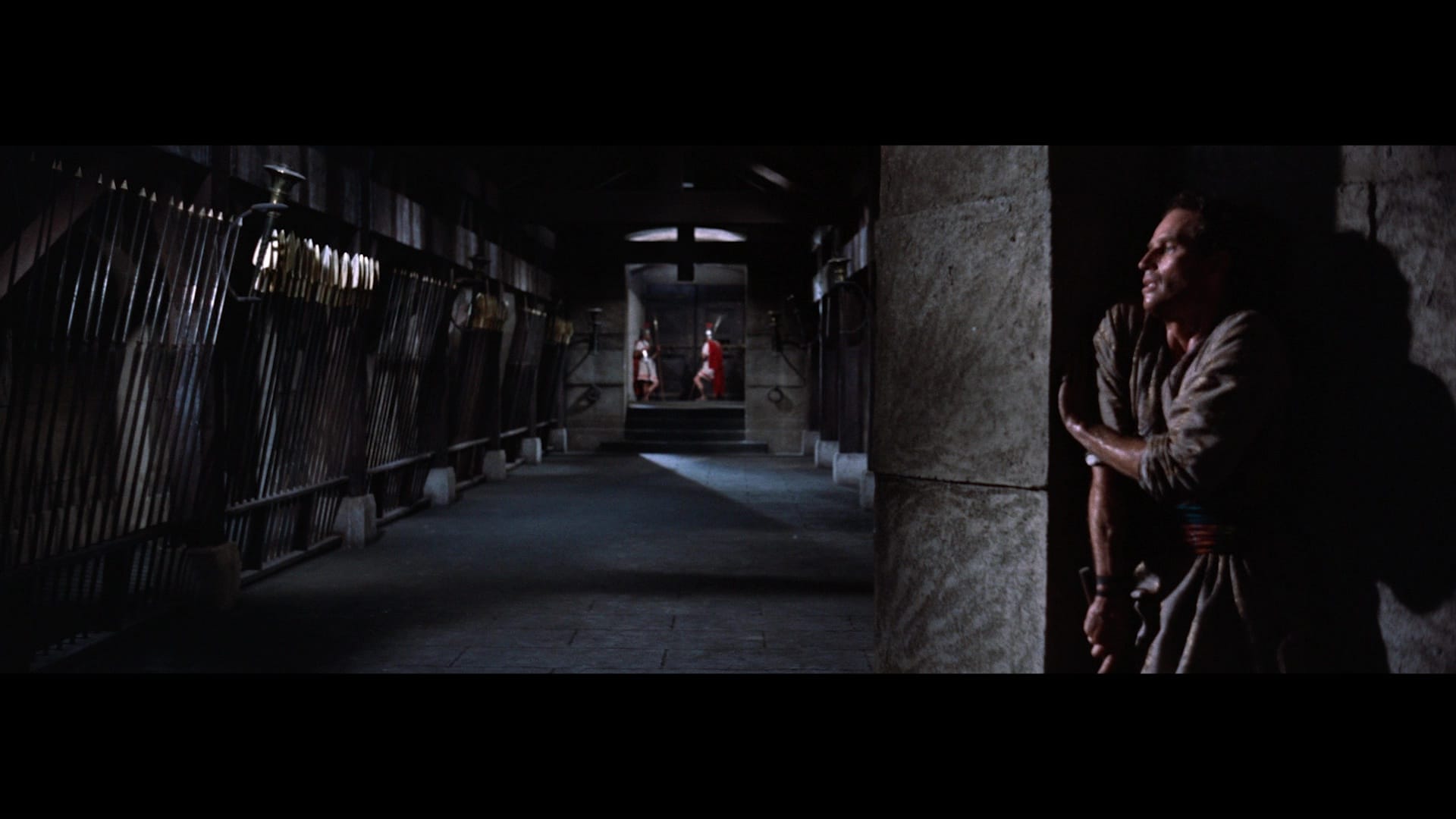
It took months to ready the film for scanning, elaborate digital algorithms were employed to remove the waveform-like distortions left on the celluloid, and the results were quality-checked by Warner’s technicians over and over again. The final product was pristine, even projected on a massive screen in Lincoln Center. (There was an audio sync issue on the day, but that wasn’t the restoration’s fault.)
Warner’s 4K edition of Ben-Hur appears to employ a new 8K scan, or at least a more recent one; even discounting the jump in resolution, it seems just a little bit sharper and brighter than the previous release. (Or maybe it’s just that we can finally see just how clean Jesus’ clothes are in comparison to everyone else’s.)
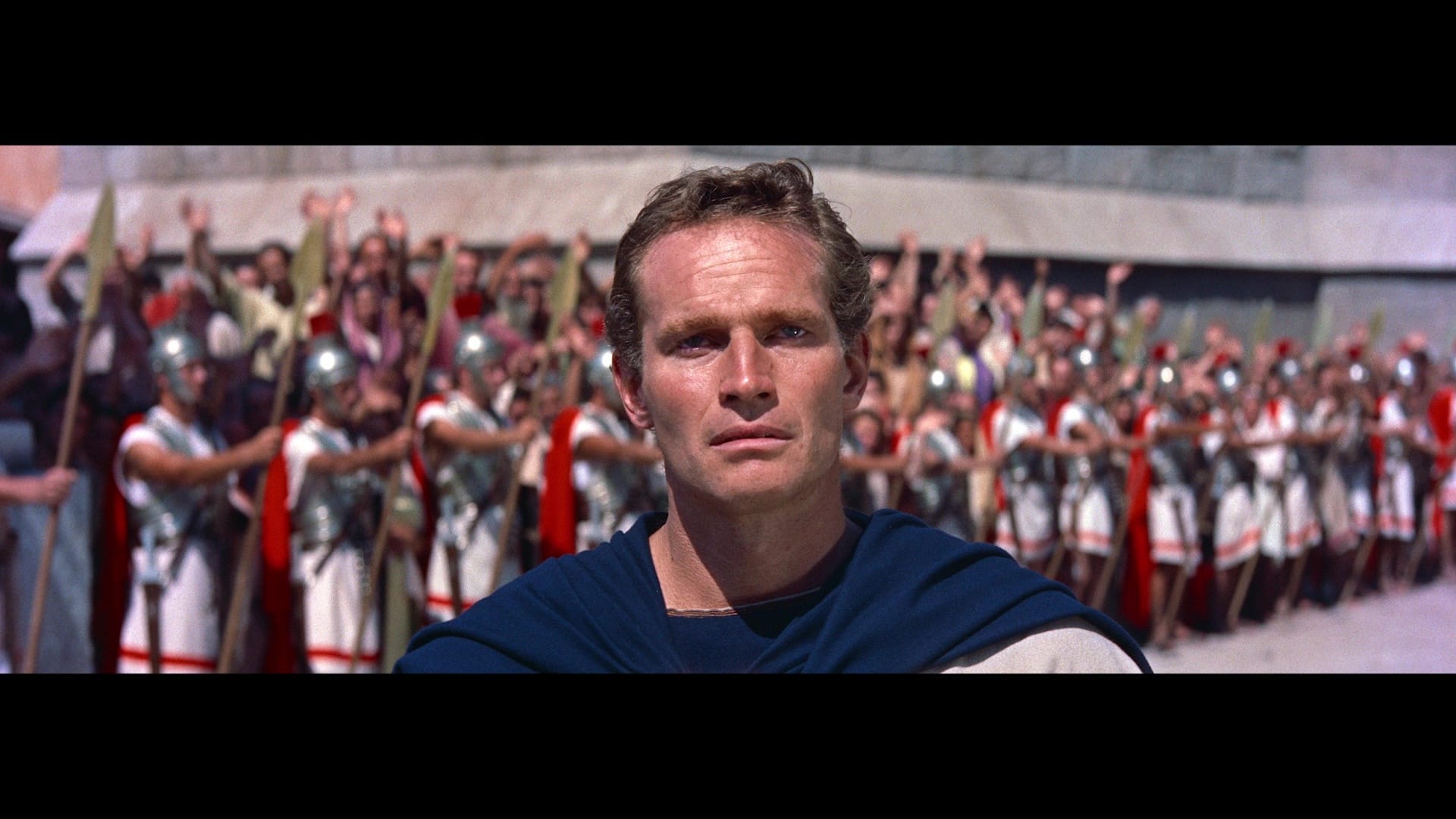
The wider color gamut of HDR lets daylight scenes surge with life, and brings out richer browns and blues in darker interiors. And unlike All the President’s Men, Ben-Hur has been remixed for Dolby Atmos – but the original multichannel soundtrack is also included, presented in DTS-MA 5.1 (but mislabeled as 5.0). Spread over two 4K discs, breaking at the intermission, the feature can also be watched with Miklós Rósza’s isolated score or the commentary track Heston and historian T. Gene Hatcher recorded for the 2001 DVD.
The rest of the set’s extras are offset onto a supplemental Blu-ray, and as with All the President’s Men, they’re impressive if not comprehensive.
Two new featurettes assemble a group of experts – Sinners DP Autumn Durald Arkapaw, Deadline’s Pete Hammond, film historian Tony Maietta, the Academy Museum director of film programs K.J. Relth-Miller, and Panavision image technology specialist Tommy Rose – for quick-bite commentary on the film’s production and legacy (“Anatomy of an Epic”) and its still-dazzling large-format sprawl (“The Cinematography of Scale”).
Carried forward from the 50th anniversary Blu-ray set are “Charlton Heston & Ben-Hur: A Personal Journey”, “The Making of an Epic,” “A Journey Through Pictures” and a gallery of screen tests that’s arguably most notable now for having Leslie Nielsen in the mix as a potential Messala. The set’s hour-long “The Epic That Changed Cinema” is not included, nor are the gallery of newsreels or the highlights from the 1960 Academy Awards. I don’t know that any of that was absolutely essential, but if you’re fond of them you’ll want to hold onto your Blu-ray box. But even with that caveat, this is an exceptional release that stands with Warner’s best discs – and that’s really saying something.
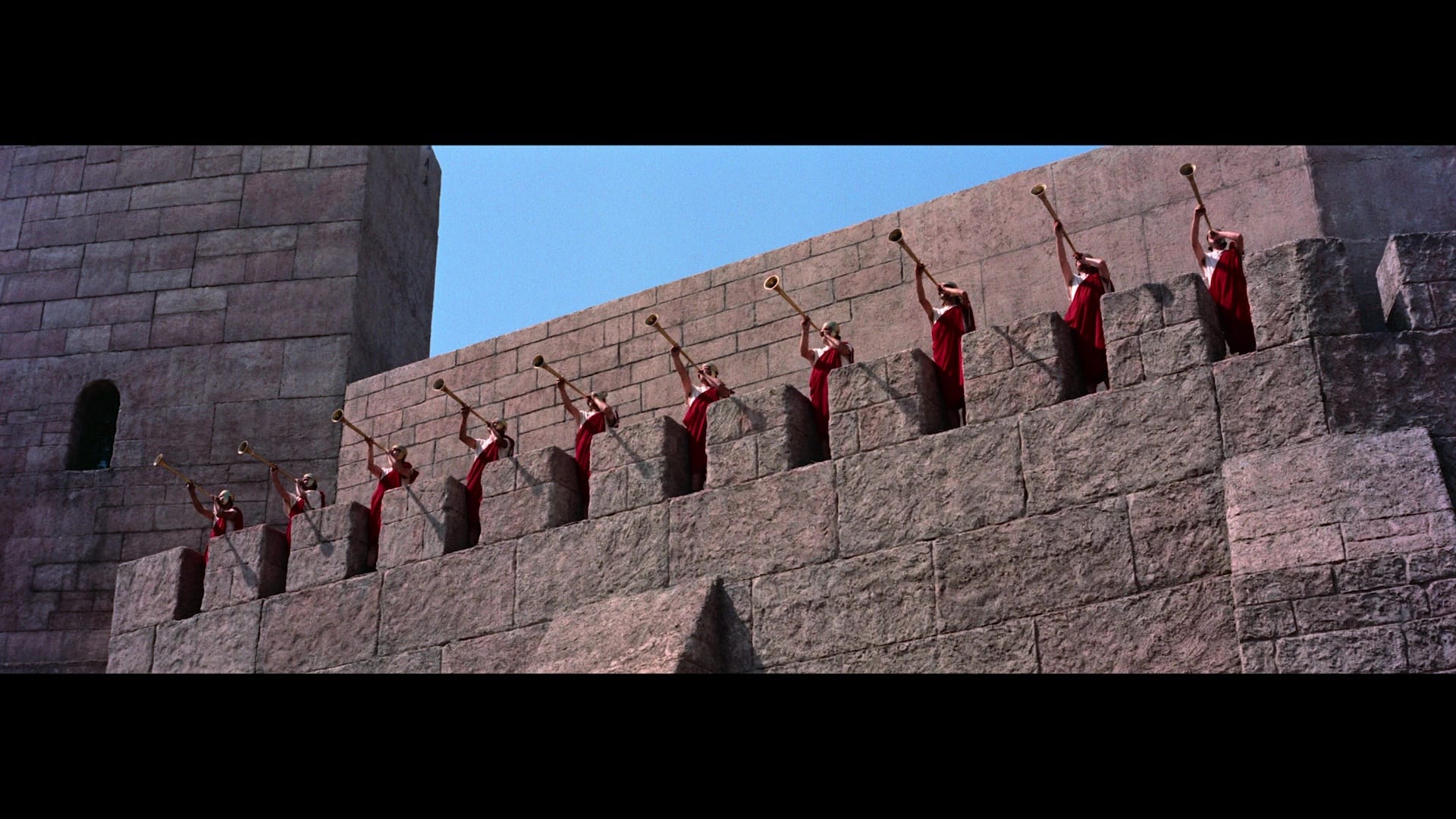
Want a sense of Warner’s overall commitment to treating its catalogue with respect? Three more Warner Archive Collection multi-disc sets were released last week, and they’re all corkers. This piece is long enough already, and all of these titles have been released separately, but now they’re considerably cheaper – the US retail works out to just ten dollars per disc – and arranged to appeal to library types like myself. And the restorations are massive improvements on previous DVD editions – especially when it comes to the Technicolor productions.

There’s the Broadway on the Big Screen 6-Film Collection, which assembles Warner’s existing Blu of Guys and Dolls and the Warner Archive releases of Brigadoon, Damn Yankees, Gypsy, The Pajama Game and The Boyfriend. The range of stars is dizzying – from Gene Kelly and Cyd Charisse to Brando and Sinatra to Gwen Verdon and Natalie Wood and Doris Day and, yes, Twiggy.
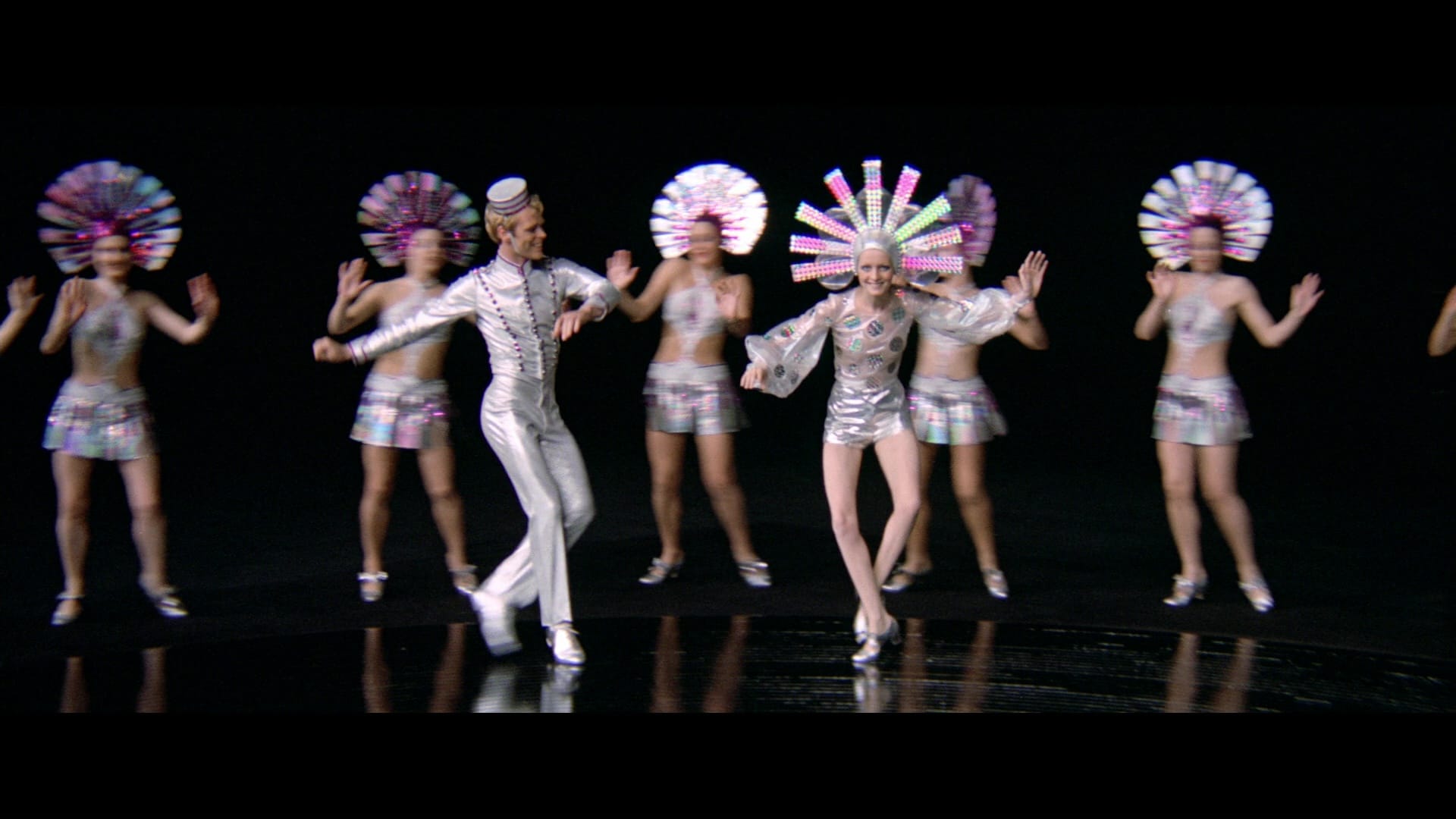
There’s at least one set piece in each picture that’ll send you spinning, and if you haven’t seen The Boyfriend in ’scope you have no idea what Ken Russell was going for. Busby Berkeley would have killed for Panavision.
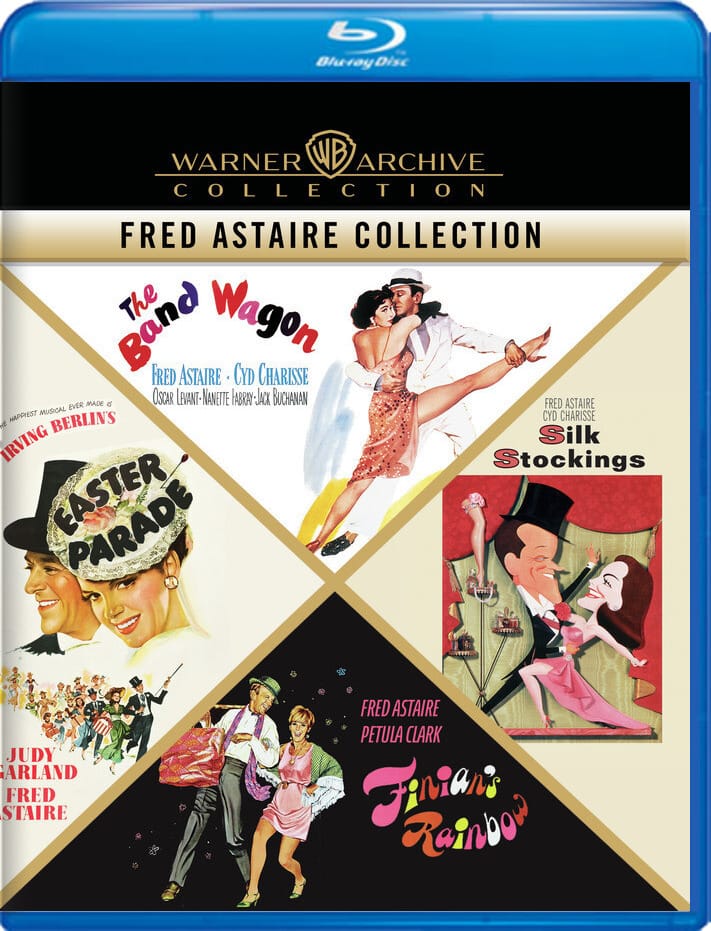
Next there’s the Fred Astaire 4-Film Collection, gathering Warner’s Blus of Easter Parade and The Band Wagon and WAC’s discs of Silk Stockings and Finian’s Rainbow.
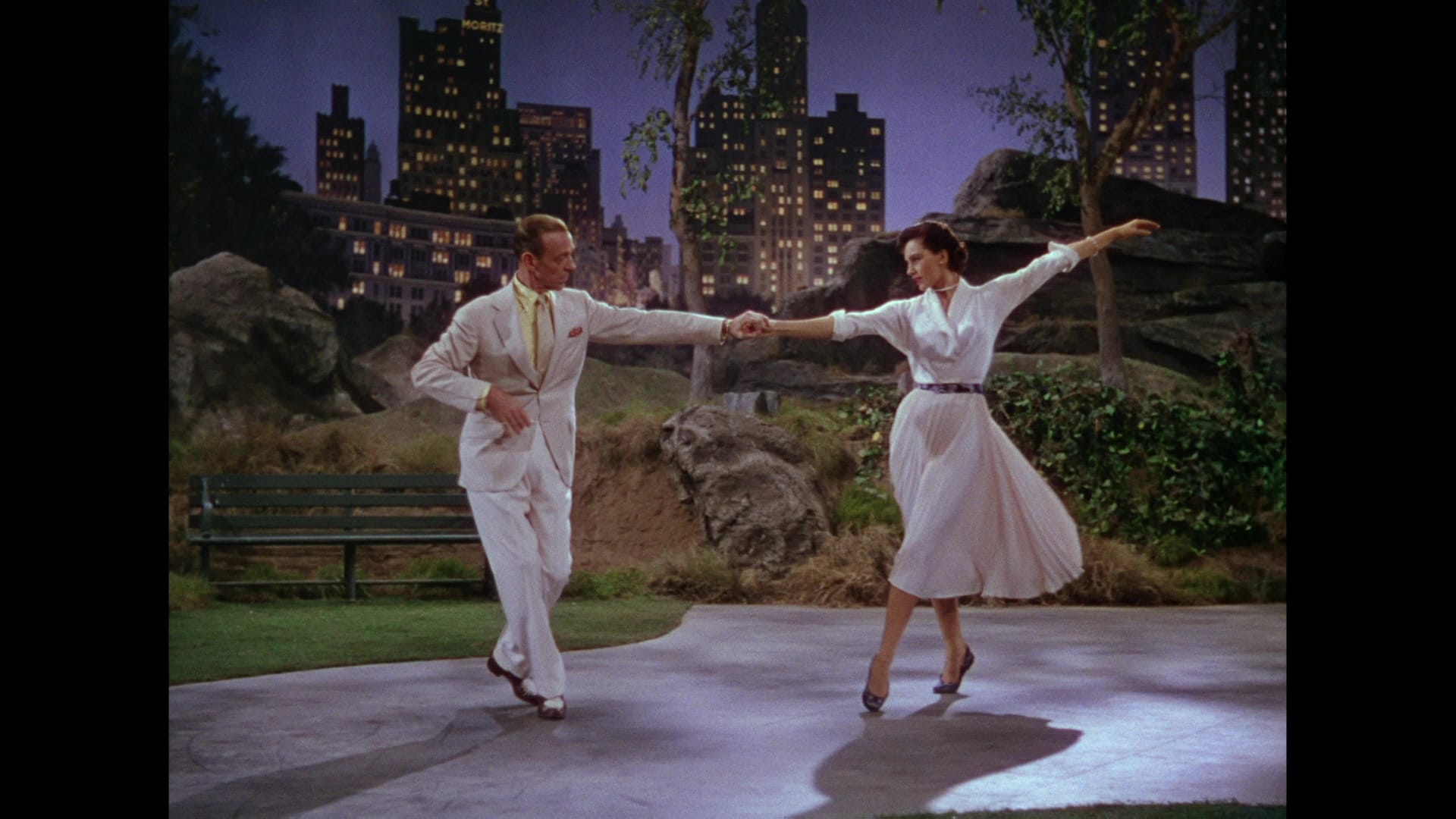
The set spans twenty years in a hoofer’s career and an entire epoch in movie musicals – with knockout numbers in Easter Parade and The Band Wagon giving way to a somewhat gentler reunion with The Band Wagon’s Charisse in Silk Stockings’ musical spin on Ninotchka. And a decade after that, there’s Astaire doing his best to keep Finian’s Rainbow afloat as Francis Ford Coppola struggles with the weight of his first studio picture. (But it looks great.)

Finally there’s the Spencer Tracy 4-Film Collection, an all-Archive quartet of Fury, Libeled Lady, Northwest Passage, and Bad Day at Black Rock. A Fritz Lang revenge picture, a fleet newspaper comedy, a King Vidor historical epic (the first half of one, anyway) and an early CinemaScope thriller from John Sturges that now looks like the first neo-Western; Tracy was an unfailingly upright and engaging screen presence. I was delighted for the opportunity to dig into his filmography. Northwest Passage might be even clunkier than Ben-Hur, but look at that Technicolor range:
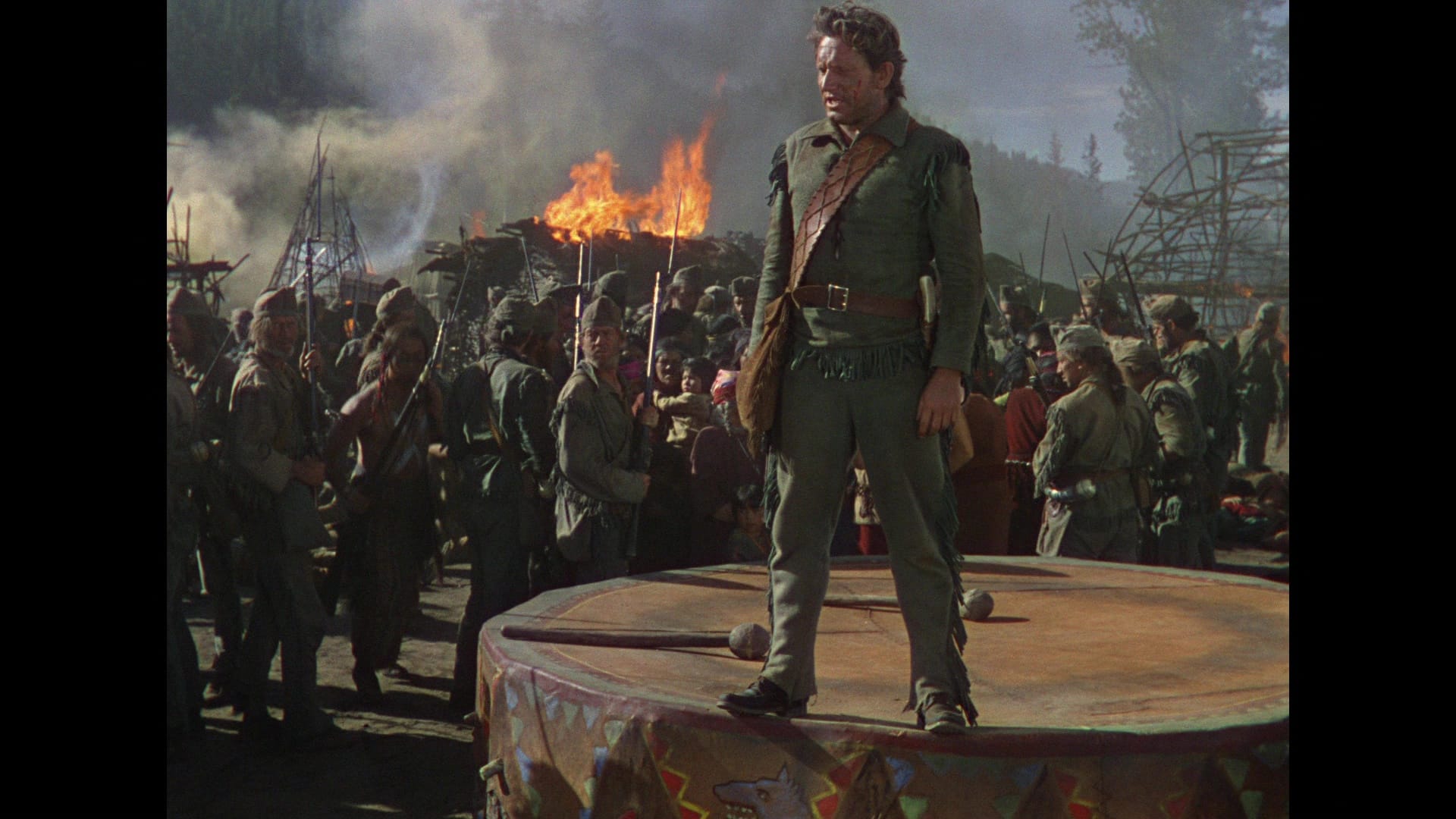
So, yes. These releases are terrific little multipacks; if something appeals, snag it! And WAC plans to keep them coming; next month’s sets are devoted to the works of Tennessee Williams and Humphrey Bogart. Really, how bad can Baby Doll be?
All the President’s Men and Ben-Hur are now available in 4K from Warner Bros. Discovery Home Entertainment; the Broadway on the Big Screen 6-Film Collection, the Fred Astaire 4-Film Collection and the Spencer Tracy 4-Film Collection BD sets are available under the Warner Archive Collection imprint.